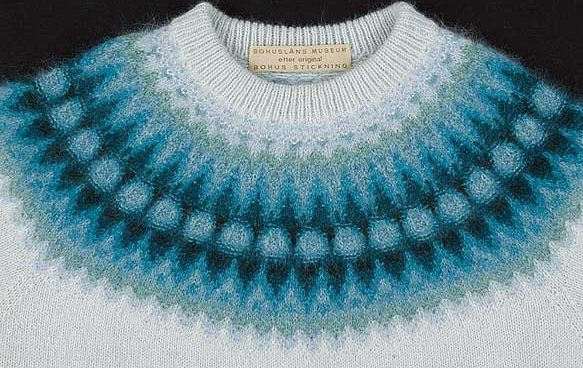
Bohus knitting in fine wool yarn.
The knitting technique was probably invented in Italy in the 13th or 13th century. One of the oldest images of knitting is a Madonna picture painted by Ambrogio Lorenzetti's workshop in Siena sometime in the first half of the 1300s. Here, four knitting needles and yarn are used in several colors. The knitting technique came to the Nordic countries in the 16th century. The oldest location comes from Malmö, where Michel Hanssen's building record from 1558 occupies "a knotty meadow ski run". In Uppsala Cathedral there is a mitten that reportedly belonged to Sten Svantesson Sture who fell in the Sea Battle at Bornholm. The mitt is a ladylike he received as a love lien and has the inscription that Freuchen Sofia belonged to Sofia Vasa. Bishop Jens Nilsen's books of vision from 1574-1597 state that Karine Gyldenstierne, when she was put in a monastery there in 1550, learned to knit. During the 17th century, knitting quickly outstripped the former needle-binding technique. The reason for the rapid breakthrough for knitting was that wool yarn was easy and cheap to obtain, that knitted articles were considered to have a more beautiful appearance, but above all that knitting is much faster than needle binding. An older Hellenic word for knitting is binding. Many garments are knitted. Factory knitted fabric used for, for example, t-shirts and underwear is called knitwear and is more elastic than woven fabric. In recent decades, knitting has again come into fashion. There are currently many knitted garments in the fashion stores. These are often machine knitted, something that a knitter can clearly see.